
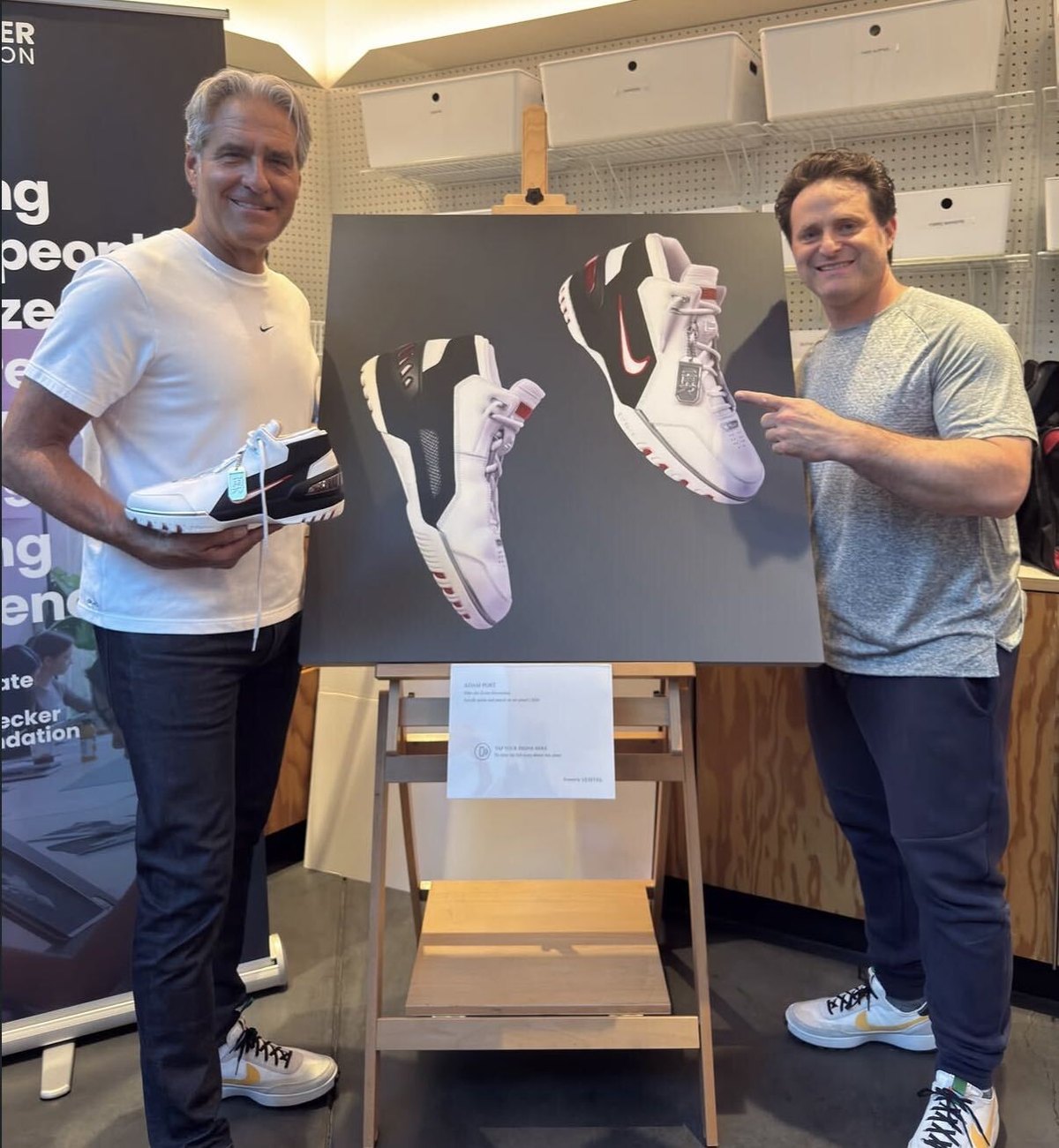
Last week in Oregon we unveiled a new piece by Adam Port: LeBron's first Nike shoe, reimagined, with a Veritas chip inside it.
Tap the piece with your phone and its whole history comes up.
Great to unveil it with @Nike CEO Elliott Hill and the shoe's designer, Aaron Cooper.
More about Veritas
Each chip is bound to a digital certificate of authenticity. The chip proves the object is real. The certificate holds everything the object knows about itself.
For brands
Three things tend to matter to brand leaders, in this order.
Counterfeits. You already know your fakes are good. The useful shift is that authentication stops being an expert judgment call and becomes something any customer, any reseller, and any customs officer can perform in two seconds with a phone they already own.
The resale market. Right now your pieces trade secondhand and you see none of it. No data, no relationship, no control over how your work is represented. A chipped piece means every resale is a verified transaction you can see, and the buyer arrives already connected to you rather than to a reseller's authentication service.
EU Digital Product Passports. The 2027 mandate is coming, and most brands are treating it as a compliance cost. It does not have to be. The infrastructure that satisfies the regulation is the same infrastructure that gives you provenance, resale visibility, and a direct line to secondhand owners. Build it once and it does both jobs.
The practical question is manufacturing. The chip has to go into your production process, which means a conversation with your factory, not just your marketing team. We handle that part with you.
If you are an artist
Different problem, same chip.
Your certificate of authenticity is currently a piece of paper. Paper gets lost, gets separated from the work, gets forged, and gets contested after you are gone. Every artist who has dealt with an authentication board knows how much rests on documentation that a fire could destroy.
Embedding a chip in the work means:
The COA cannot be lost or faked. It is inside the piece. A collector, a gallery, or an auction house verifies it in seconds without needing you to confirm anything.
You control the record. Exhibition history, ownership transfers, conservation notes, your own words about the work. All of it attaches to the object and travels with it permanently.
Your studio's authority outlives the paperwork. The chain of provenance starts at your hand and continues without gaps.
For the Adam Port piece, the chip went into the work itself.
What getting started looks like
For brands, the first step is a pilot: one product line, one production run, chips integrated at the factory alongside your existing process. Most of the work is manufacturing coordination, and it is less disruptive than people expect.
For artists and studios, it is simpler. We work directly with you or your fabricator on placement, then you control what the certificate says.
If you are thinking about it, book a demo. Tell us what you make and how it is made, and we will tell you honestly whether this is a fit.